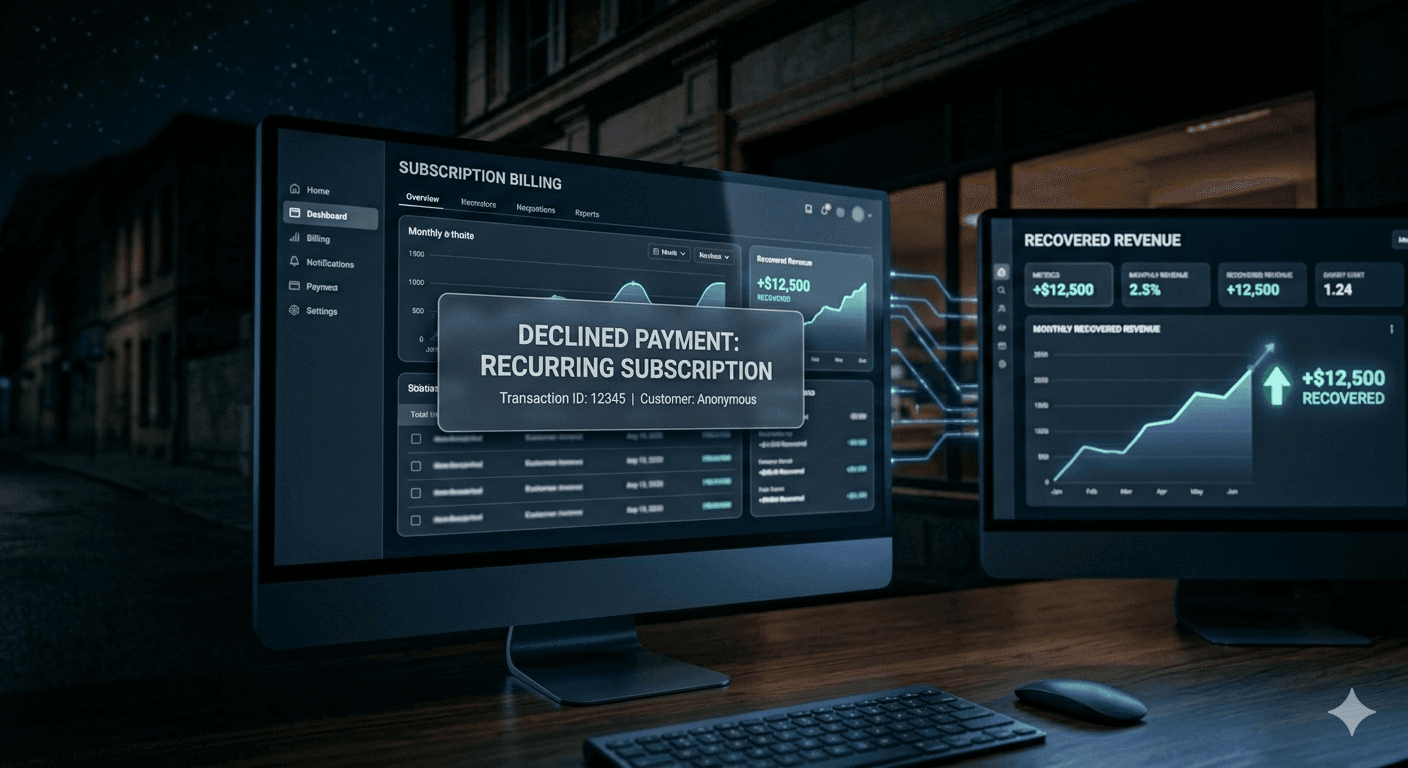
There's a good chance your churn rate is lying to you.
Not on purpose. Most subscription dashboards lump two completely different problems under the same "churned" label: customers who decided to leave, and customers whose card got declined. The first requires product work and retention strategy. The second needed a working retry system — and maybe an email.
According to Recurly's research, involuntary churn — the kind caused by payment failures, not cancellation decisions — represents 20–40% of total churn in subscription businesses. In high-risk sectors, it climbs to 48%. These aren't customers who left. Their billing infrastructure failed them, and most companies never got them back.
The difference between losing them and recovering them comes down to one number: your payment recovery rate. And the range between a bad one and a good one is much wider than most people expect.
What is payment recovery rate?
Payment recovery rate is the percentage of initially failed payments you successfully collect before losing the subscriber. If 100 payments fail in a month and your system recovers 68 of them, your recovery rate is 68%.
Simple metric. The benchmarks are where it gets interesting.
What the averages actually look like
The industry average across all recovery approaches sits between 47% and 53%, per Monetizely's analysis of subscription billing data. Here's the fuller picture by approach:
| Approach | Typical Recovery Rate | |---|---| | Single retry (no logic) | ~23% | | Static retry schedule | 40–60% | | Automated dunning with email | 50–70% | | Smart/optimized dunning | 70–85% | | Top-performing SaaS | 80–85%+ |
Sources: Slicker B2C Benchmarks 2025, Kaplan Group, Monetizely
The 50-point gap between a single retry and a smart dunning system isn't a minor tweak. At any meaningful ARR, it represents hundreds of thousands of dollars from the same customer base, without acquiring a single new subscriber.
Why payment failures aren't all the same problem
This is what most static retry systems miss.
Payment failures have different root causes, and each one needs a different fix. About 42% of all subscription payment failures come from expired or replaced cards — credentials that went stale, not from a cardholder who can't pay. Another 26–30% are insufficient funds, which are often timing-dependent: that same card might clear on the 1st or 15th after payday. Around 39% show up as generic declines with no specific reason attached, which means you're retrying blind.
A static system treats all of these identically. Wait three days. Try again. Send an email. Cancel if nothing clears.
Smart dunning routes by failure type instead. Expired cards get flagged before the payment even attempts, through card-on-file update services that sync new card details automatically. Insufficient funds trigger retries timed to pay cycles. Generic declines get routed through alternate banking paths to test whether the issue is the card or the processor.
In a well-configured system, the subscriber often has no idea any of this happened.
What the infrastructure actually does
There are four components that make smart payment recovery work at the processor level.
Card account updater. This runs before failures happen. Visa Account Updater (VAU) and Mastercard Automatic Billing Updater (ABU) automatically refresh card-on-file details when a card is replaced, reissued, or expires. A payment processor with this built in intercepts a large share of expired-card failures before they ever reach the retry queue. Our payment processing infrastructure runs this as an automated batch process — no merchant action required. Account updater services recover 3–5% of recurring revenue that would otherwise be lost to stale credentials alone.
Configurable retry rules. Not every decline should get another attempt. An "insufficient funds" soft decline is temporary and retriable. A "stolen card" hard decline should never be retried. A system that routes by error code, BIN, payment method, country, and transaction amount gives you control over which failures get queued for recovery — and how many attempts each one gets before moving to customer notification.
Bank failover routing. Sometimes a decline is a routing failure, not a cardholder problem. If the primary banking path declines, routing the retry through a secondary processor or alternate payment method often clears it. This catches a class of failures that has nothing to do with the customer's actual ability to pay.
Auth messaging. How a retry is presented to the issuing bank affects whether it's approved. Adjusting authorization messaging on retry attempts can meaningfully improve issuer acceptance — particularly for subscriptions, where issuers sometimes flag recurring charges more aggressively than one-time purchases.
None of these require the customer to do anything. That's the point.
The dollar math
Take a concrete example. A $10M ARR SaaS company at the industry-average transaction failure rate of 7.9% has roughly $790,000 in revenue at risk from failed payments annually — per Kaplan Group's 2025 research.
With a single retry recovering 23%: $182,000 saved. $608,000 lost.
With smart dunning recovering 68%: $537,000 saved. $253,000 lost.
That's a $355,000 annual difference on the same customer base. And it understates the real impact, because 38% of a recovered subscriber's total lifetime revenue comes after the recovery event. You're not saving one billing cycle — you're saving the relationship. Recurly's data shows recovered subscribers extend their subscription by a median of 141 days after a recovery event.
This is why effective dunning consistently generates 10–15x ROI. The upside isn't a saved payment. It's saved subscriber lifetime value.
Where your recovery rate probably sits right now
| Recovery Rate | What it usually means | |---|---| | Below 40% | One retry attempt, no email follow-up, or both | | 40–60% | Some automation, static schedule, possibly a payment-failed email | | 60–75% | Retry logic and dunning emails coordinating | | 75–85% | Smart retry with rule-based routing by failure type | | 85%+ | Infrastructure and email sequence both optimized |
Your payment processor's reporting should show this number. If it doesn't surface it directly, calculate it: recovered failed payments divided by total failed payments over the last 90 days.
B2B SaaS recovers better than direct-to-consumer subscriptions — business customers pay closer attention to billing failure notices. Fitness and subscription boxes have higher failure rates and harder recovery curves, partly from higher debit card usage. The performance gap between basic and smart dunning holds across all categories. The absolute numbers shift, but the relative improvement is consistent.
For more on how payment processing setup affects subscription revenue, and why interchange-plus pricing changes the economics of recurring billing, those posts have the broader context.
Frequently Asked Questions
What is the average payment recovery rate for smart dunning in SaaS?
Smart dunning systems typically achieve payment recovery rates between 70% and 85% for SaaS businesses. The industry average across all approaches is 47–53%. Top-performing SaaS companies recover 80% or more of failed payments by combining card account updaters, configurable retry rules by error code, and dunning email sequences. Companies relying on a single retry attempt recover around 23%.
How is payment recovery rate calculated?
Payment recovery rate = (recovered failed payments ÷ total failed payments) × 100. A 70% recovery rate means 7 out of every 10 declined transactions were eventually captured before the subscriber was lost. Most payment processors and subscription billing platforms surface this in their analytics dashboards.
What's the difference between smart dunning and basic retry logic?
Basic retry logic re-attempts a failed payment on a fixed schedule regardless of why it failed. Smart dunning routes retries based on the specific decline code, payment method, customer location, and failure history — and combines processor-level retry with card account updaters and customer notification. Companies using intelligent retry logic recover 68% of failed payments, compared to 23% for single-retry approaches.
How much revenue does smart dunning recover?
For a $10M ARR SaaS company with a 7.9% payment failure rate, the at-risk revenue pool is roughly $790,000 per year. Smart dunning recovering 68% saves approximately $537,000. A single-retry approach recovering 23% saves about $182,000. The difference between the two is roughly $355,000 annually from the same customer base.
What causes most subscription payment failures?
About 42% of subscription payment failures come from expired or replaced cards (Churnkey, State of Retention 2025). Another 26–30% are insufficient funds. Around 39% appear as generic declines. Each cause needs a different fix: expired cards require a card account updater, insufficient funds require timed retries, and generic declines need alternate routing paths.
Does involuntary churn count in your overall churn rate?
Yes — and that's the problem. Most subscription analytics combine involuntary churn (payment failures) with voluntary churn (deliberate cancellations) in a single metric. This makes your product look worse than it is and hides a recoverable problem. Involuntary churn represents 20–40% of total subscription churn. Unlike voluntary churn, fixing it doesn't require product improvements.
Most retention discussions focus on product work, cancellation flows, and customer success outreach. Those matter. But if 20–40% of your churned users never made a decision to leave, none of that addresses what's actually happening.
The difference between a 23% recovery rate and a 70%+ rate is infrastructure — card updaters that catch stale credentials before payments fail, retry rules that route by failure type, and fallback paths when primary processors decline.
If you don't know your current recovery rate, that's the first thing to find out. The math on what you're losing is quick to run, and the fix is at the processor level.
Talk to ClickWerxs about smart payment recovery for your subscription business.